How many steps per day should you really aim for when taking tirzepatide? Between the myths of 10,000 steps and scientific recommendations, discover realistic and personalized goals to optimize your treatment with GLP-1 agonists.
The Origin of the 10,000-Step Myth
The figure of 10,000 steps per day originates from a 1965 Japanese marketing campaign for the ‘manpo-kei’ pedometer (literally ‘10,000-step meter’). This round number has no original scientific basis. However, recent studies have partially validated this target as a useful benchmark, while also showing that health benefits begin much earlier.
A landmark study published in The Lancet (2022) analyzing 78,500 adults via accelerometer shows that the optimal benefit is between 8,000 and 10,000 steps/day for those under 60, and between 6,000 and 8,000 steps/day for those over 60. Beyond this, additional benefits are marginal.
Step Goals Adapted for Patients on GLP-1
When taking tirzepatide, goals must be personalized based on baseline activity level, treatment tolerance, and comorbidities. Here is a progressive framework recommended by physiotherapists specializing in obesity:
- Phase 1 – Baseline (weeks 1-2): Wear a pedometer without changing your habits. Note your average daily step count. This is your starting point.
- Phase 2 – Increment (weeks 3-8): Add 500 to 1000 steps per day each week. If you start from 3000 steps, aim for 4000 then 5000.
- Phase 3 – Consolidation (weeks 9-16): Reach and maintain 7000-8000 steps/day. This is the threshold where cardiovascular and metabolic benefits are maximal.
- Phase 4 – Optimization (beyond 16 weeks): If desired, progress towards 10,000 steps. Incorporate brisk walking (cadence > 100 steps/min) for 30 minutes.
Intensity Matters as Much as Volume
Recent research shows that walking cadence is as important as volume. A JAMA Neurology (2023) study demonstrates that 30 minutes of walking at a cadence greater than 100 steps/minute (brisk walking) produces superior benefits to an hour of slow walking. On tirzepatide, this brisk walking improves insulin sensitivity by an additional 20%.
The concept of ‘peak 30’ (the 30 most active minutes of your day) is an increasingly used indicator. Aim for a cadence of 100-110 steps/minute during these 30 minutes, even if they are not consecutive.
Dose-Dependent Benefits with GLP-1 Treatment
- 3000-4000 steps/day: 20% reduction in mortality risk, mood improvement.
- 5000-6000 steps/day: Significant improvement in blood glucose and cholesterol, better bowel transit.
- 7000-8000 steps/day: 40% reduction in cardiovascular risk, optimized weight loss on tirzepatide.
- 8000-10,000 steps/day: Maximal benefits for overall health, improved body composition.
- Beyond 12,000 steps/day: Marginal additional benefits, risk of overtraining if fatigued on GLP-1.
Tracking Tools and Motivation
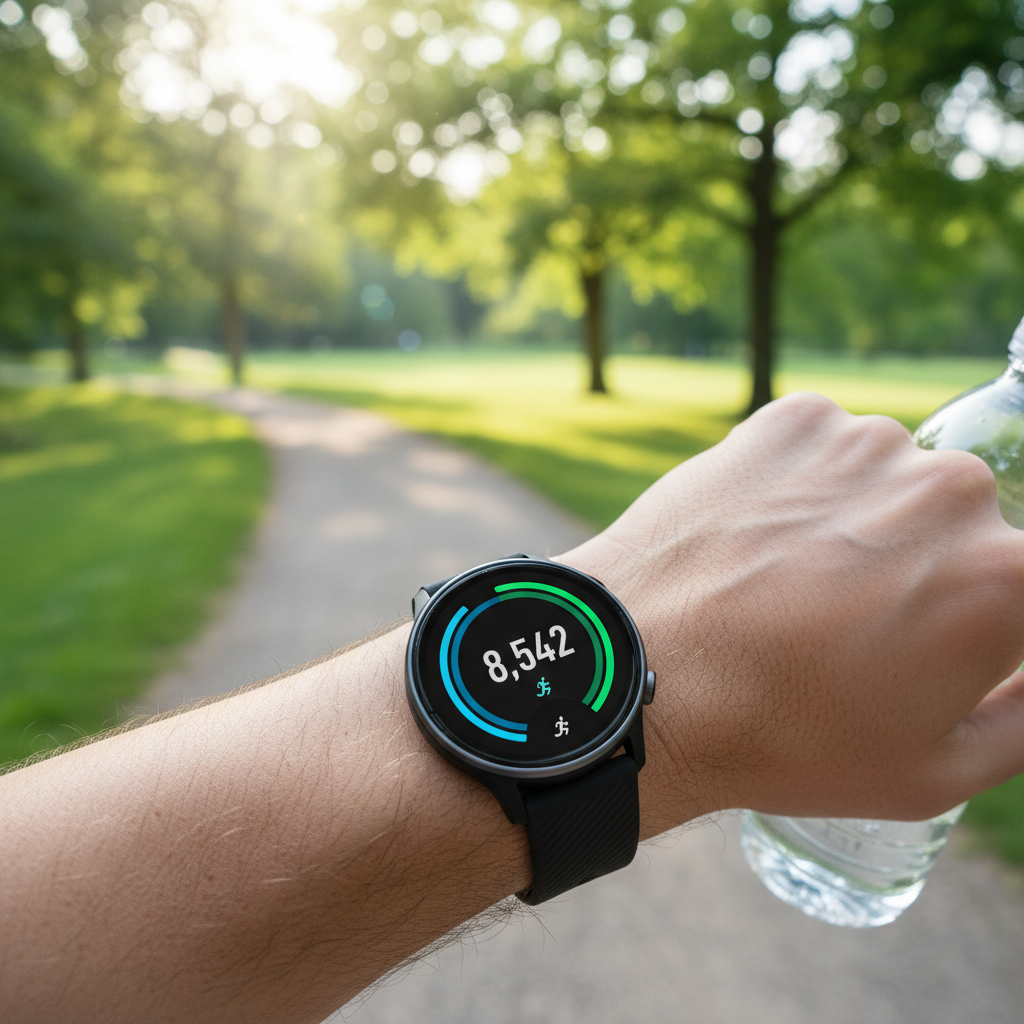
Modern smartphones automatically count steps (Apple Health, Google Fit). Smartwatches (Apple Watch, Garmin, Fitbit) offer more precise tracking and activity reminders. The MounjaGO application integrates this data for a comprehensive dashboard of your progress during treatment.
The ‘micro-habit’ technique is effective: associate walking with an existing habit. Walk during your morning coffee, walk around the block after each meal, take a phone call while walking. These automatisms accumulate without conscious effort.
Track your progress with the MounjaGO app.
FAQ
How many steps per day on tirzepatide?
The optimal goal is 7000 to 10,000 steps per day, achieved progressively. Start at your current level and add 500-1000 steps per week. Health benefits are significant from 5000-6000 daily steps.
Are 10,000 steps necessary on GLP-1?
No, 10,000 steps is a marketing benchmark, not a medical recommendation. Studies show that maximal benefits are achieved from 8000 steps/day. Cadence (brisk walking > 100 steps/min) matters as much as the total number.
How to increase daily steps on Mounjaro?
Integrate walking into your habits: get off one stop earlier, walk during calls, take a 15-minute walk after each meal. Use a pedometer or smartwatch to quantify your progress.