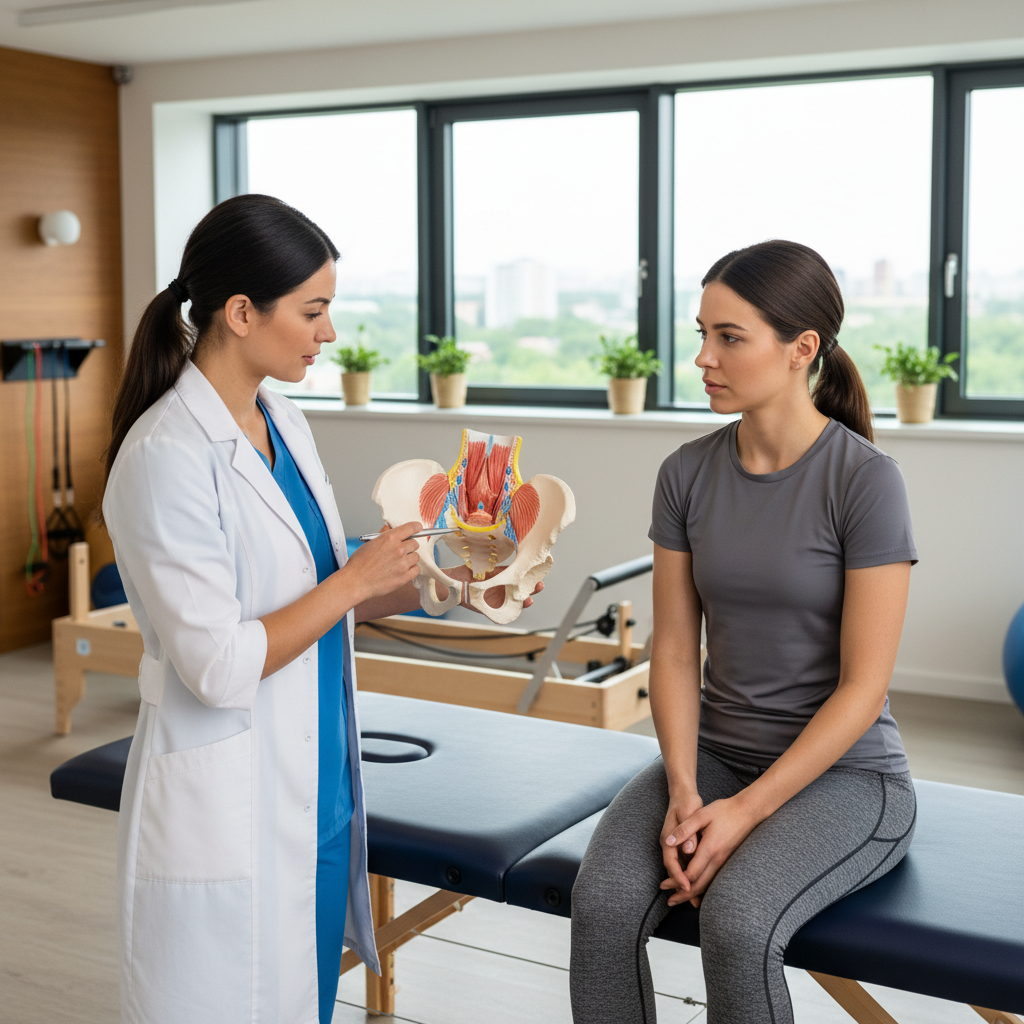
Pelvic floor strengthening is a rarely discussed but essential exercise for obese patients, especially during weight loss with GLP-1 agonists. Urinary incontinence affects 60% of obese women and 30% of men, and it significantly improves with perineal rehabilitation.
The Pelvic Floor: An Overlooked Muscle in Obesity
The pelvic floor is a group of muscles that support the bladder, uterus (in women), and rectum. Excess weight exerts constant pressure on these muscles, gradually weakening them. A study from the International Urogynecology Journal (2023) shows that for every 5 kg of overweight, the risk of stress urinary incontinence increases by 20%.
With tirzepatide, rapid weight loss relieves this pressure, but already weakened muscles do not spontaneously strengthen. Furthermore, coughing and vomiting (common GLP-1 side effects) increase intra-abdominal pressure and worsen existing urinary leakage.
Kegel Exercises: Technique and Program
Kegel exercises involve contracting and relaxing the pelvic floor muscles. To identify them, imagine you are trying to stop the flow of urine mid-stream (do not actually do this; it’s just to identify the correct muscles). The contraction should be felt in the perineum, not in the abs, glutes, or thighs.
- Basic Kegel: Contract the pelvic floor for 5 sec, relax for 5 sec. Repeat 10 times. 3 sets per day.
- Quick Kegel: Contract-relax rapidly 10 times in a row. 3 sets per day. Strengthens muscle reactivity.
- Progressive Kegel: Contract 25%, then 50%, then 75%, then 100%. Hold each level for 2 sec. 5 repetitions, 2 sets.
- Varied Position Kegel: Practice lying down (easy), sitting (moderate), and standing (difficult) for functional strengthening.
- Perineal Bridge: Classic glute bridge with simultaneous perineal contraction. 3 x 10 repetitions.
Benefits for Patients on GLP-1
- Reduction in stress urinary incontinence by 50 to 70% in 8-12 weeks (Cochrane Review, 2024).
- Improved anal continence (useful if diarrhea occurs with tirzepatide).
- Better posture and lumbar support thanks to deep ‘core’ strengthening.
- Improved sexual function (sensitivity, control, satisfaction).
- Prevention of genital prolapse linked to rapid weight loss.
When to Consult a Specialist
If Kegel exercises alone are not sufficient after 8 weeks of regular practice, consult a physiotherapist specializing in perineal rehabilitation. Advanced techniques (biofeedback, functional electrostimulation, hypopressive exercises) may be necessary.
Do not hesitate to discuss the topic with your doctor, even if it is uncomfortable. Urinary incontinence is a common, treatable medical problem, not an inevitability. Urinary pads are available for transition phases, and tirzepatide treatment often improves the situation thanks to the reduction of weight pressing on the pelvic floor.
Track your progress with the MounjaGO app.
FAQ
Does urinary incontinence improve with GLP-1 induced weight loss?
Yes, every 5 kg reduction improves incontinence by 20%. However, Kegel exercises remain necessary because weakened muscles do not spontaneously strengthen with weight loss.
How to perform Kegel exercises correctly?
Contract the muscles you would use to stop the flow of urine, without contracting your abs or glutes. Hold for 5 seconds, relax for 5 seconds, 10 repetitions, 3 times a day. Progress over 8-12 weeks.
Should men also strengthen their pelvic floor while on Mounjaro?
Yes, 30% of obese men suffer from urinary incontinence. Kegel exercises also improve erectile function and urinary control in men. The program is the same as for women.
Free tool — check your BMI and weight-loss projection.
Related Reading on
- Daily Walking and GLP-1: The Most Underestimated Exercise
- SURMOUNT-2: Tirzepatide in Diabetic and Obese Patients
- Fatphobia and GLP-1 Treatment: Combating Stigma
- 10,000 Steps: Myth or Reality? Moving More with GLP-1 Agonists
- Yoga and Mounjaro: Combined Physical and Mental Benefits
Further reading : SURMOUNT-1 trial in the New England Journal of Medicine.
To track the effect on your own curve, logged data beats vague recollections on the day of your appointment: the MounjaGO app brings together weight, doses, side effects and meals, and turns them into a PDF report for your doctor — $12 for lifetime access, no subscription.