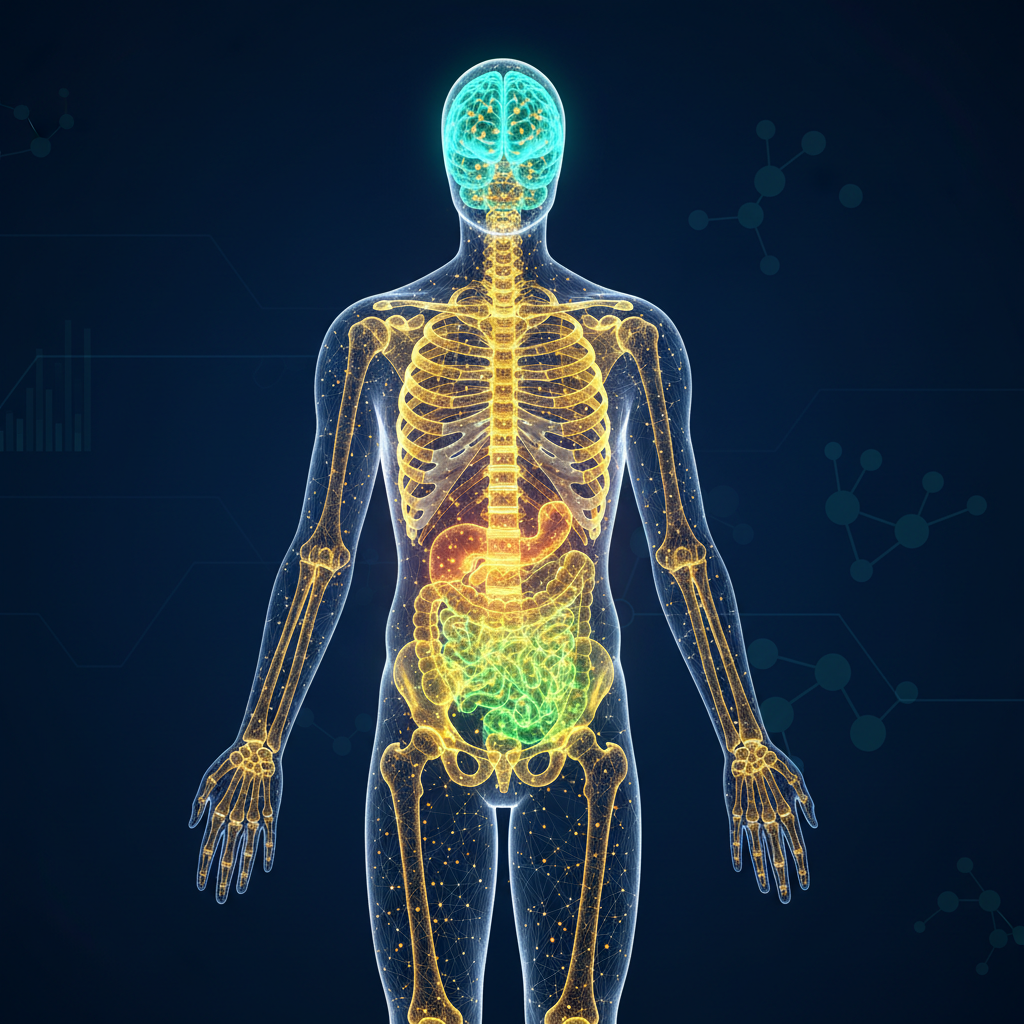
GIP receptors are the distinctive element that sets tirzepatide apart from all other GLP-1 treatments. Their presence in adipose tissue, the brain, and bones explains why Mounjaro produces superior results compared to GLP-1 mono-agonists in terms of weight loss, body composition, and metabolic markers.
Anatomy of a Receptor: The GIP-R
The GIP receptor (GIP-R, or GIPR) is a G protein-coupled receptor (GPCR) belonging to the secretin receptor family (class B). It is composed of 466 amino acids and forms a structure with 7 transmembrane domains, typical of GPCRs.
When GIP (or tirzepatide) binds to the GIP-R, it primarily activates the cAMP/PKA signaling pathway (cyclic adenosine monophosphate / protein kinase A). This signaling cascade leads to different cellular effects depending on the tissue involved.
Distribution of GIP Receptors in the Body
The mapping of GIP receptors directly explains the clinical effects of tirzepatide:
| Organ/Tissue | GIP-R Expression | Effects of Activation |
|---|---|---|
| Pancreatic beta cells | Very high | Glucose-dependent insulin secretion |
| White adipose tissue | High | Lipolysis, insulin sensitivity, browning |
| Brown adipose tissue | Moderate | Thermogenesis, energy expenditure |
| Hypothalamus | Moderate | Appetite reduction, reward modulation |
| Osteoblasts (bone) | Moderate | Bone formation, mineralization |
| Stomach | Low | Gastric acid secretion |
| Heart | Low | Cardioprotective effects (under study) |
Source : Campbell JE, Drucker DJ, Cell Metab, 2013 ; Muller TD et al., Nat Rev Drug Discov, 2022.
The GIP-R in Adipose Tissue: The Metabolic Revolution
It is in adipose tissue that the GIP-R makes the biggest difference compared to pure GLP-1 agonists. GLP-1 receptors are virtually absent from adipose tissue, while the GIP-R is highly expressed there.
Effects of GIP-R activation in adipose tissue:
1. Fat Mobilization: Sustained pharmacological activation of the GIP-R stimulates lipolysis (breakdown of stored triglycerides into free fatty acids). This mechanism is paradoxical: physiologically, post-prandial GIP promotes fat storage. However, continuous pharmacological activation (like that of tirzepatide) reverses this effect, promoting the mobilization of lipid reserves (Samms et al., Cell Metab, 2023).
2. Improved Insulin Sensitivity: The GIP-R reduces chronic inflammation in adipose tissue (reduction of pro-inflammatory M1 macrophages) and improves insulin signaling in adipocytes. This effect contributes to reducing systemic insulin resistance.
3. Browning of White Adipose Tissue: GIP-R activation in white adipose tissue induces the expression of UCP1 protein (uncoupling protein 1), normally exclusive to brown adipose tissue. This « browning » increases resting energy expenditure through thermogenesis, a mechanism absent in pure GLP-1 agonists.
4. Preservation of Lean Mass: By promoting weight loss primarily from fat mass (85% in SURMOUNT-1), GIP-R activation in adipose tissue contributes to better body composition than that observed with GLP-1 alone or caloric restriction.
The GIP-R in the Brain: The Second Satiety Pathway
Recent studies (Kaneko et al., Cell Metabolism, 2023) have identified neuronal populations expressing the GIP-R in several brain regions:
- Lateral hypothalamus: modulation of food motivation and food-seeking behavior
- Paraventricular nucleus: regulation of energy balance and basal metabolism
- Insular cortex: integration of taste and satiety signals
- Amygdala: regulation of emotional response to food
Activation of these GIP-R neurons in the brain produces an appetite reduction that is complementary and additive to that produced by GLP-1R activation. The neuronal pathways involved are distinct, which explains the superiority of dual agonism over GLP-1 mono-stimulation.
The GIP-R and Bone Health
A potential, often overlooked, advantage of tirzepatide concerns the bones. The GIP-R is expressed on osteoblasts (cells that build bone). GIP-R activation stimulates:
- Osteoblast proliferation
- Production of bone matrix (type 1 collagen, osteocalcin)
- Bone mineralization
This mechanism could partially counteract the bone density loss often associated with significant weight loss. Pure GLP-1 agonists do not have this effect, as GLP-1 receptors are not significantly expressed on osteoblasts.
Clinical data from the SURMOUNT program have not shown significant deterioration of bone mineral density under tirzepatide, an encouraging result that, however, requires longer-term studies.
The GIP Paradox: Friend or Foe of Obesity?
The biology of GIP-R in obesity has long been debated:
Arguments against GIP (before tirzepatide):
- Physiological post-prandial GIP promotes fat storage
- GIP levels are elevated in obese patients
- Animal models (GIP-R knockout mice) show resistance to diet-induced obesity
- Some researchers proposed GIP-R antagonists as anti-obesity treatments
Arguments for GIP (revealed by tirzepatide):
- Sustained pharmacological activation reverses the lipogenic effects of physiological GIP
- GIP-R in the brain reduces appetite in a complementary way to GLP-1
- Adipocyte browning via GIP-R increases energy expenditure
- Clinical results (SURMOUNT) unambiguously demonstrate the superiority of dual agonism
The resolution of this paradox lies in the difference between intermittent physiological stimulation (pulsatile, post-prandial) and continuous pharmacological stimulation (permanently elevated levels). The context of stimulation determines the direction of the metabolic effect.
Key Takeaways
GIP receptors are the key that differentiates tirzepatide from all GLP-1 agonists. Their presence in adipose tissue allows for direct fat mobilization and adipocyte browning, which are impossible with GLP-1 alone. In the brain, they activate complementary satiety pathways. And in the bones, they maintain bone formation during weight loss. It is this multi-tissue action via the GIP-R that explains the clinical superiority of tirzepatide.
FAQ
Why don’t other treatments target GIP?
Historically, GIP was considered lipogenic (promoting fat storage). Tirzepatide has demonstrated that sustained pharmacological activation reverses this effect. New dual and triple agonist molecules now integrate GIP into their mechanism.
Does GIP-R explain better muscle preservation with Mounjaro?
In part. By promoting weight loss primarily from fat mass (85%), GIP-R activation in adipose tissue indirectly preserves lean mass. The direct effect on muscle is not yet fully elucidated.
Does GIP have an effect on bones?
Yes. The GIP-R is expressed on osteoblasts, and its activation stimulates bone formation. This is a potential advantage of tirzepatide compared to pure GLP-1 agonists during weight loss.
Can GIP-R be blocked instead of activated?
Yes, anti-GIP-R antibodies are under development (such as Amgen’s AMG-133, an anti-GIP-R antibody coupled with a GLP-1 agonist). Phase 1 results show promising weight loss, suggesting that GIP-R blockade can also be effective, likely through different mechanisms.
How many GIP-Rs are there in the body?
GIP receptors are expressed in many tissues but with varying densities. The highest concentrations are found in the pancreas and adipose tissue. The brain expresses moderate but functionally important levels.
Sources
- Samms RJ et al. GIPR agonism mediates weight-independent insulin sensitization by tirzepatide. J Clin Invest. 2023;133(16):e160651.
- Kaneko K et al. GIPR signaling in hypothalamic neurons reduces food intake. Cell Metab. 2023.
- Campbell JE, Drucker DJ. Pharmacology, physiology, and mechanisms of incretin hormone action. Cell Metab. 2013;17(6):819-837.
- Muller TD et al. GIP and GLP-1 as therapeutic targets. Nat Rev Drug Discov. 2022;21:513-532.
- Jastreboff AM et al. SURMOUNT-1. NEJM. 2022;387:205-216.
Free tool — check your BMI and weight-loss projection.
Related Reading on
- Mounjaro vs Ozempic: Essential Pharmacological Differences
- Zepbound vs Mounjaro: Same Molecule, Different Indications
- GLP-1 and GIP: Understanding the Two Hormones Targeted by Mounjaro
- Mounjaro vs Wegovy: Which Treatment to Choose in 2026?
- Tirzepatide: Mechanism of Action of the Dual GIP/GLP-1 Agonist
Further reading : SURMOUNT-1 trial in the New England Journal of Medicine.
To track the effect on your own curve, logged data beats vague recollections on the day of your appointment: the MounjaGO app brings together weight, doses, side effects and meals, and turns them into a PDF report for your doctor — $12 for lifetime access, no subscription.