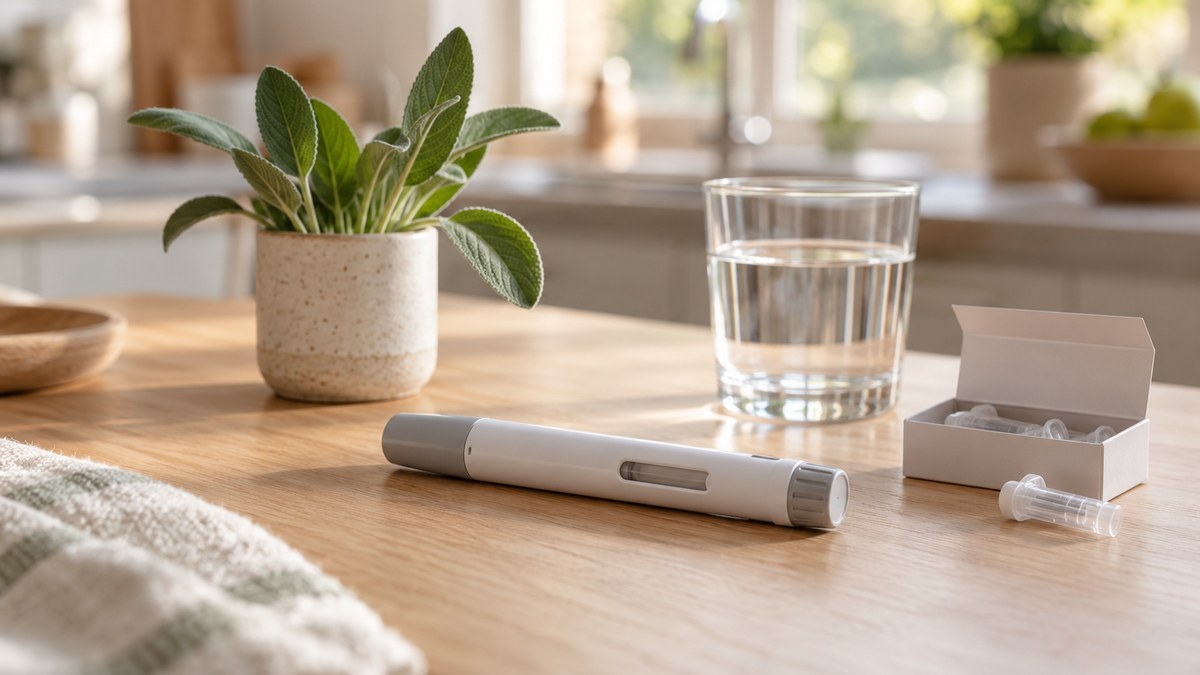
Mounjaro dosages: the official schedule starts at 2.5 mg once a week for 4 weeks, moves to 5 mg, then rises if needed in 2.5 mg steps of at least 4 weeks each, up to a maximum of 15 mg a week (EU product information, EMA). The 2.5 mg dose is the way into treatment, not its goal: it gives your body time to adjust before the doses that do most of the work.
Mounjaro dosages: what is the official schedule from 2.5 mg to 15 mg?
The official Mounjaro dosages are six weekly doses: 2.5 / 5 / 7.5 / 10 / 12.5 / 15 mg. Treatment always starts at 2.5 mg, moves to 5 mg after 4 weeks, and every later increase is made in 2.5 mg steps after at least 4 weeks on the current dose. The step people ask about most, from 2.5 mg to 5 mg, has its own article.
Here is what the European summary of product characteristics (SmPC) says, dose by dose. The last column is our own arithmetic: the earliest week a dose can be reached if every increase happens after exactly 4 weeks, which is never an obligation.
| Weekly dose | Status in the SmPC | Earliest |
|---|---|---|
| 2.5 mg | Starting dose, for 4 weeks | Week 1 |
| 5 mg | Recommended maintenance dose | Week 5 |
| 7.5 mg | Intermediate step (2.5 mg increase) | Week 9 |
| 10 mg | Recommended maintenance dose | Week 13 |
| 12.5 mg | Intermediate step (2.5 mg increase) | Week 17 |
| 15 mg | Recommended maintenance dose and maximum dose | Week 21 |
The SmPC lists 5, 10 and 15 mg as the recommended maintenance doses for adults and 15 mg a week as the maximum. Nothing requires you to go through the whole table: the official wording is “if needed”, and the decision to step up belongs to your prescriber.
Why does Mounjaro start at 2.5 mg?
Mounjaro starts at 2.5 mg because that dose is for treatment initiation, not for the full effect. The US label for tirzepatide, sold for weight management as Zepbound, says in plain terms that 2.5 mg is for initiation and is not approved as a maintenance dose, and that the escalation is meant to reduce the risk of gastrointestinal side effects.
Those digestive effects are the practical reason for the schedule. The EU SmPC states that nausea, diarrhoea and vomiting were more frequent during the dose-escalation period and decreased over time. In the placebo-controlled weight-management phase 3 study described in section 4.8, gastrointestinal disorders affected 55.6%, 60.8% and 59.2% of people on 5, 10 and 15 mg versus 30.3% on placebo, and were mostly mild or moderate. These are trial-group proportions, not a forecast of your own experience.
For the general logic of a gradual build-up, see our article on why Mounjaro doses are increased gradually.
How long do you stay on each Mounjaro dose?
You stay on each Mounjaro dose for at least 4 weeks before any increase. That “at least” matters: the SmPC says increases can be made in 2.5 mg steps after a minimum of 4 weeks on the current dose, so a longer step is allowed if your prescriber thinks it useful, but a shorter one is not.
The SURMOUNT trials followed the same logic: 2.5 mg for 4 weeks, then 2.5 mg increases every 4 weeks until the assigned dose, according to section 5.1 of the SmPC. The full build-up, with what to expect at each stage, is in our guide to the Mounjaro dose escalation schedule.
How do you decide whether to go up a dose or stay put?
The decision to go up a dose or stay at the current step belongs to the prescriber, who weighs response against tolerability. No official text sets a numeric threshold of weight or symptoms that would trigger an increase automatically: the SmPC says “if needed”, and the FDA label asks prescribers to consider treatment response and tolerability when choosing the maintenance dose.
The FDA label adds a useful line: if a maintenance dose is not tolerated, a lower maintenance dose can be considered. In other words, the maximum dose is neither a required stop nor a goal in itself. To prepare that conversation, facts are what count: your weight week after week, the dose injected, the effects you felt and how strong they were.
Which article should you read for each Mounjaro dose?
Every step of the Mounjaro dosage schedule has its own article on the blog, so you can go deeper without repeating this overview. Here is where to find the detail for each step, from the first 2.5 mg to the 15 mg maximum.
- Moving to 5 mg: transitioning from 2.5 mg to 5 mg.
- What the 5 mg dose delivers: Mounjaro 5 mg, how much weight loss to expect.
- The whole build-up: the dose escalation schedule and why it is gradual.
- The maximum dose: Mounjaro 15 mg, for whom and when.
- The “golden dose”: why the hidden fifth dose is a bad idea.
- A missed injection: what to do and how to catch up.
- The injection and the pen: the step-by-step injection guide, pen storage rules and what to do if the pen seems defective.
There is currently no blog article dedicated to the 7.5, 10 or 12.5 mg doses: in the SmPC they are steps along the way, covered in the escalation schedule.
What does a Mounjaro KwikPen contain?
A Mounjaro KwikPen is a multi-dose pre-filled pen holding 2.4 ml of solution, which is four doses of 0.6 ml: one injection a week for four weeks. The strength printed on the pen (2.5, 5, 7.5, 10, 12.5 or 15 mg) is the amount of tirzepatide delivered per injection, so each pen holds four times that amount in total.
| KwikPen | Tirzepatide per injection | Tirzepatide in the pen (4 doses) |
|---|---|---|
| 2.5 mg/dose | 2.5 mg in 0.6 ml | 10 mg in 2.4 ml |
| 5 mg/dose | 5 mg in 0.6 ml | 20 mg in 2.4 ml |
| 7.5 mg/dose | 7.5 mg in 0.6 ml | 30 mg in 2.4 ml |
| 10 mg/dose | 10 mg in 0.6 ml | 40 mg in 2.4 ml |
| 12.5 mg/dose | 12.5 mg in 0.6 ml | 50 mg in 2.4 ml |
| 15 mg/dose | 15 mg in 0.6 ml | 60 mg in 2.4 ml |
The SmPC also notes that the KwikPen is only one presentation: single-dose pens and vials exist too, and needles are not included with the KwikPen. In the US, the Zepbound label likewise lists vials, single-dose pens and the multi-dose KwikPen, and asks that patients are trained on the specific presentation they receive.
Is the liquid left in the KwikPen a fifth dose?
The liquid left in a Mounjaro KwikPen after the fourth injection is not a fifth dose. The SmPC explains that each pen has excess volume for priming, and that trying to inject any leftover medicine results in an incomplete dose even though the pen still has product in it.
The so-called “golden dose”, a fifth injection supposedly drawn from the pen, therefore rests on a reading that contradicts the leaflet. We cover it in detail in our article on the golden dose.
What do the labels say about a missed dose or a change of injection day?
If a Mounjaro injection is missed, the SmPC says to give it as soon as possible within 4 days after the missed dose; after more than 4 days, skip it and take the next dose on the regular day. Either way, the weekly schedule then carries on as normal. The FDA label for Zepbound states the same rule, as 4 days or 96 hours.
Both documents also allow the weekly injection day to be changed if needed, as long as at least 3 days (72 hours in the FDA label) separate two doses. These are the official rules, not personal instructions: if your situation is unclear, your pharmacist or prescriber decides. The practical walk-through is in the missed injection article.
What do clinical trials show for each Mounjaro dose?
Clinical trials show that average weight loss rises with the Mounjaro dose. In SURMOUNT-1, a 72-week placebo-controlled trial reported in table 8 of section 5.1 of the SmPC, participants lost on average 16.0%, 21.4% and 22.5% of their body weight on 5, 10 and 15 mg, versus 2.4% on placebo.
| SURMOUNT-1 group (72 weeks) | Average weight change | Participants losing at least 10% |
|---|---|---|
| 5 mg | −16.0% | 73.4% |
| 10 mg | −21.4% | 85.9% |
| 15 mg | −22.5% | 90.1% |
| Placebo | −2.4% | 13.5% |
Two cautions apply. First, these are group averages with wide variation between people. Second, SURMOUNT-1 compared 5, 10 and 15 mg: it says nothing about the intermediate steps taken on their own. To go deeper on the two ends of the schedule, see what to expect at 5 mg and the case of the 15 mg maximum.
How do you keep track of your Mounjaro doses?
To keep track of your Mounjaro doses week after week, write down the date, the dose and the effects you felt at every injection. That log makes the conversation with your doctor concrete when a step-up is on the table. You can also estimate your starting point with the BMI calculator and weight-loss projection.
The MounjaGO app lets you record your weight, each injection with its dosage and site, and your side effects every week, then build a report to show your doctor. On cost, compare Mounjaro prices and coverage: conditions vary by country and indication and change over time, so we fix no figure here.
What are the limits of this information?
The information on Mounjaro dosages describes the official scheme of a medicine, not a prescription: it cannot tell you which dose suits you, or when to step up or stay put. It rests on regulatory texts and on trial averages, and several limits frame how to read it.
- The official texts we read (EU SmPC, FDA label) set minimums and maximums, not a numeric criterion for choosing between “step up” and “stay”.
- SURMOUNT-1 randomised three maintenance doses (5, 10 and 15 mg): we have no comparison of the same kind for 7.5 and 12.5 mg.
- The percentages for digestive effects and weight loss are trial averages; they do not predict one person’s experience.
- The documents consulted do not quantify any benefit of a step longer than 4 weeks, so we give no figure on that.
- The scheme applies to adults. The SmPC sets specific maintenance doses for adolescents and children aged 10 and over with type 2 diabetes (5 and 10 mg, maximum 10 mg), which fall outside this page.
- Brand names differ: the FDA label we used covers Zepbound, the US brand for weight management, and the FDA sets 10 or 15 mg as the maintenance dose for sleep apnoea; the EU SmPC covers Mounjaro. Price, available presentations and coverage vary by country, and no amount is fixed here.
Frequently asked questions
What are the Mounjaro doses?
The six weekly Mounjaro doses are 2.5, 5, 7.5, 10, 12.5 and 15 mg. Treatment starts at 2.5 mg, moves to 5 mg after 4 weeks, then rises in 2.5 mg steps after at least 4 weeks on the current dose, up to a maximum of 15 mg a week (EU SmPC).
Is Zepbound the same as Mounjaro for dosing?
Both contain tirzepatide and follow the same escalation: 2.5 mg for 4 weeks, then 5 mg, then 2.5 mg steps after at least 4 weeks, to a maximum of 15 mg. Zepbound is the US brand name for weight management; the FDA label we read is for Zepbound, the EU document for Mounjaro.
Why start at 2.5 mg if it is not meant for weight loss?
Because 2.5 mg is an initiation dose: the FDA label says it is not approved as a maintenance dose. It lets the body adjust before the increases, the period when digestive side effects are more frequent according to the EU SmPC.
Can you stay on 5 mg or 10 mg?
Both 5 mg and 10 mg are recommended maintenance doses in the SmPC, and nothing requires reaching 15 mg. Choosing the maintenance dose is done with your prescriber, based on response and tolerability.
How many doses are in a Mounjaro KwikPen?
A KwikPen holds four doses of 0.6 ml, which is 2.4 ml of solution, whatever its strength. The liquid left after the fourth injection should not be injected: the SmPC says it would give an incomplete dose.
Sources
- European Medicines Agency, Mounjaro: summary of product characteristics (sections 2, 4.2, 4.8, 5.1, 6.5). ema.europa.eu, accessed on .
- European Medicines Agency, Mounjaro: EPAR. ema.europa.eu, accessed on .
- US Food and Drug Administration, Zepbound (tirzepatide): prescribing information, revised February 2026, sections 2.1 to 2.4. accessdata.fda.gov, accessed on .
Medical disclaimer. This article is for information only and does not replace medical advice. It describes the official Mounjaro dosing scheme, not a prescription: no dose, step or timing should be decided, changed or stopped without your doctor or pharmacist. The figures quoted are clinical-trial averages and do not predict your individual result. Information current as of 5 October 2026.