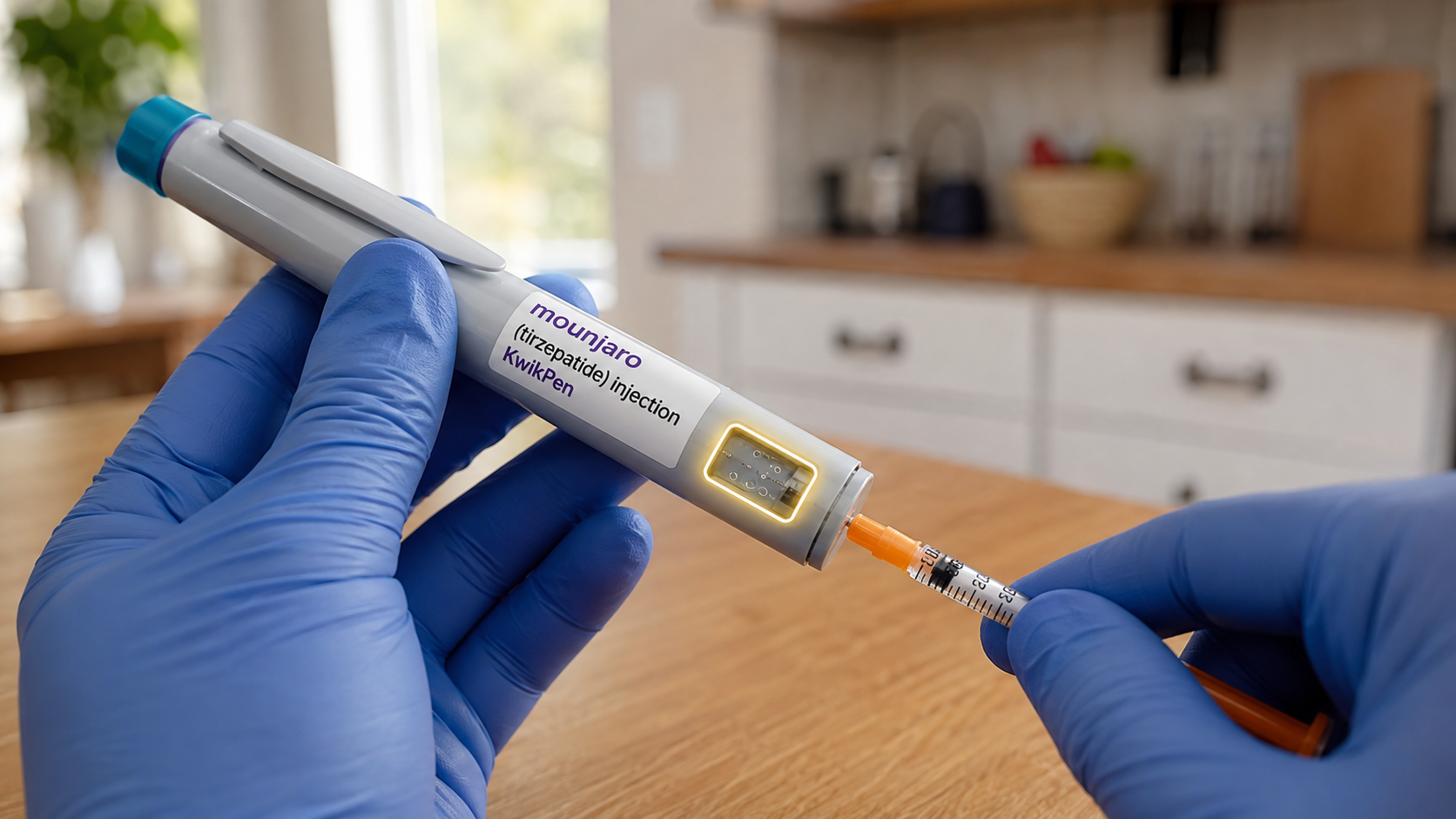
A hidden “fifth dose” in a pen designed to deliver four: on TikTok and Reddit, the Mounjaro “golden dose” has become one of the most talked-about topics among people on tirzepatide. Driven by price rises and fear of running out, some users try to salvage the liquid left in their pen after the fourth weekly injection. Eli Lilly, pharmacists and regulators such as the UK’s MHRA all say the same thing: do not do it. Here is what you need to know, with no taboo and no how-to, because there is no safe way to do it.
⚠️ Important: this article is for information only. Only a healthcare professional (your prescriber or your pharmacist) can give you real advice for your situation. If you have any doubt about your treatment, your dose or your pen, speak to your pharmacist.
What is the “golden dose”?
Each Mounjaro KwikPen is designed to deliver four weekly doses. Like most injection pens, it contains a small technical overfill: extra liquid included by the manufacturer to guarantee priming and the accuracy of the four official doses. That residue, visible in the cartridge after the fourth injection, has been nicknamed the “golden dose” by online communities.
The name is misleading. As one doctor put it, the leftover liquid is not a bonus dose, it is a deliberate overfill with a technical purpose. It was never designed to be injected.
Why the trend has exploded
The “golden dose” did not come out of nowhere. Three factors feed it. First, price: tirzepatide remains expensive, is rarely reimbursed for weight loss, and the price increases announced in 2025 and 2026 created a sense of urgency for many patients. Second, supply tensions, which fuelled the fear of being left without treatment. Third, social media, where videos viewed millions of times present salvaging the residue as an obvious money-saving hack.
The logic sounds airtight: “I paid for this pen, that liquid is mine”. Except the financial reasoning collides with a pharmaceutical reality those videos never mention.
Why healthcare professionals advise against it
The warnings all point the same way, from the manufacturer to pharmacists to regulators such as the MHRA. The reasons are concrete.
A dose that cannot be measured
The pen is a calibrated medical device: its mechanism is what guarantees that a dose is complete and precise. The residual volume is not calibrated. Trying to recover it exposes you to a double risk: underdosing (an insufficient amount that breaks the consistency of your treatment) and overdosing (an excessive amount, with nausea, vomiting, diarrhoea or hypoglycaemia as possible consequences). Either way, you are outside anything studied in clinical trials.
Sterility has a time limit
An opened pen must be discarded 30 days after first use, even if liquid remains. Beyond that point, the sterility of the contents is no longer guaranteed. Eli Lilly has explicitly warned that any attempt to “break into” the pen carries a risk of bacterial contamination, infection at the injection site, and even abscess formation. An untreated infection can escalate into a serious complication.
Off-label use, with no safety net
Salvaging the residue means using the medicine outside its marketing authorisation and outside the device designed to deliver it. If something goes wrong, you are on your own: no protocol, no safety data and no manufacturer liability covers this practice.
What Eli Lilly says (and what changes in 2026)
The manufacturer has gone beyond statements. Since April 2026, Lilly has been rolling out a redesigned KwikPen: identical in appearance and use, but modified internally to sharply reduce the liquid left after the fourth dose. In other words, the “golden dose” is physically disappearing from the pens. The signal is clear: the manufacturer treats that residue as a problem to eliminate, not a dose to give away.
The right reflex: talk, don’t tinker
If you are tempted by the “golden dose”, the real issue is rarely the residue itself: it is the cost of treatment, the fear of shortages, or a doubt about your dose. All three have legitimate answers, and they go through professionals.
Your pharmacist is your first port of call: they know your treatment, can check your injection technique, tell you what availability really looks like and warn you about risky practices. Your prescriber can reassess your dose or your treatment plan if cost has become an obstacle. What you should never do is compensate with products bought outside the pharmacy circuit. We have documented the dangers of “peptides” sold online, flagged by the French medicines agency, which thrive on exactly these frustrations.
⚠️ Reminder: no information you read online, including this article, replaces the advice of a healthcare professional. Never change the way you use an injection pen without talking to your doctor or pharmacist first.
Frequently asked questions
Is the golden dose a real dose of Mounjaro?
No. It is an uncalibrated manufacturing overfill left in the cartridge after the four official doses. It does not correspond to any clinically validated dose.
Is it dangerous to have used my pen normally for 4 weeks?
No. Used as per the leaflet (four doses, then discarded), the KwikPen is safe and accurate. The risks described here only concern attempts to extract the residue.
What should I do with my pen after the fourth dose?
Dispose of it in a sharps bin, like any injection device. Your pharmacy can provide one and explain local disposal rules.